
May 2026: Austin Startup Ecosystem Update + Event Details
Austin’s startup ecosystem enters May 2026 with record venture momentum and growing strength in AI, defense, semiconductors, space, and advanced manufacturing. Explore the startups, funding rounds, news and trends shaping the next phase of the ATX startup scene. #AustinStartups #ATXTech



In April 2026, the Austin and Texas startup ecosystem continued to gain momentum, with Austin strengthening its position as a national hub for AI, defense technology, semiconductors, robotics, space, and advanced manufacturing. The region is also experiencing one of its strongest venture capital periods on record, with major funding activity, IPO filings, strategic relocations, and new public-private initiatives pointing to a more coordinated innovation economy across Central Texas. Here is a concise breakdown of the funding, M&A activity, and strategic shifts shaping the Austin startup scene right now.
Featured Event: Austin Startup Meetup
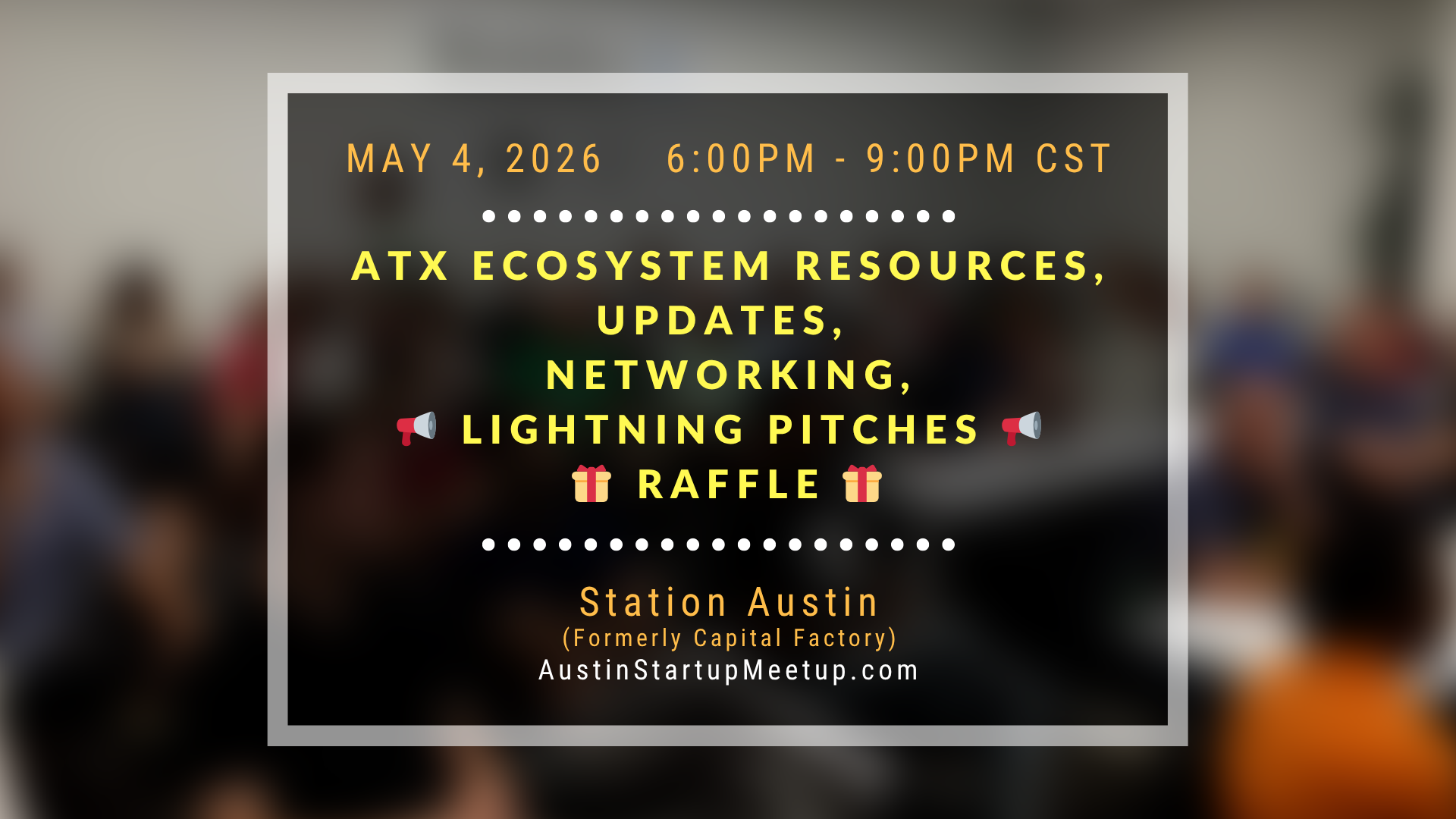
We have a great RSVP list for the Austin Startup Meetup event this August. Looking forward to see passionate founders share the exciting projects they're working on.
🛠️ ATX Ecosystem Updates & Resources
As usual, we'll start by taking a quick look at the state of the Austin startup ecosystem, talk about some news and upcoming events and provide startup resources.
📢 Lightning Pitches & Shoutouts
Then we'll get right into the most exciting part of the event. We'll welcome members from the audience to come and give lightning pitches on their startups, projects and ideas. We want entrepreneurs to come out of their comfort zone and talk about their ideas, challenges, wants and needs in an open forum of helpful members in the community.
🎁 Exclusive Raffle!
After that, we will give away a 100% FREE personal subscription that can be used with any JetBrains product of their choice.
- 📍 Voltron (1st Floor) @ Station Austin (Formerly Capital Factory)
- 🕝 May 4th, 2026 6pm-9pm CST
- 🔗 Event details and RSVP for future events here.
- 💻 Get the event presentation slides here.
Here's the slide deck for the event (Updated AFTER the event)!
Here's a list of everyone who pitched at the event (Updated AFTER the event)!
Sponsors
- Aidiyoh: Aidiyoh is a 24/7 AI music radio platform where listeners can discover AI-generated and AI-assisted music, and creators can upload their own tracks and launch a radio station. You can now also create instant lyric videos for your songs.
- Buildbonnet Web Studios: Buildbonnet is an Austin-based design and development agency creating tailored software solutions for startups and enterprises. Fill out the form on the website and mention “Austin Startup Meetup” in your inquiry for a chance to receive a free UI, UX, or product consultation.
State of the Startup Ecosystem
The startup ecosystem in April 2026 has moved beyond the easy-money era of 2020–2021 and the AI experimentation wave of 2023–2024. Investors are no longer rewarding every company with “AI” in the pitch deck; capital is concentrating around startups that can become category-defining infrastructure, vertical AI platforms, defense and robotics leaders, or durable businesses with real revenue and a credible path to profitability.
The headline funding numbers can be misleading. A handful of mega-rounds are driving much of the market, while deal activity remains selective and many Series B/C companies still face pressure. For founders, this is a market of opportunity and discipline; for investors, access, conviction, and sector expertise matter more than ever. For Austin, it is an especially important moment as the city emerges as a national hub for physical AI, robotics, defense technology, advanced manufacturing, energy infrastructure, and applied AI.
Global Trends: AI Still Dominates, But the Market Has Matured
Globally, April 2026 marks a shift from AI experimentation to a more disciplined “value creation” era. Funding headlines remain huge, with AI capturing an extraordinary share of global venture dollars, but the capital is increasingly concentrated in companies with deep technical advantages, proprietary data, infrastructure-scale opportunities, or clear vertical use cases. The market is moving away from generic AI wrappers and toward vertical AI and agentic systems built for specific industries such as healthcare, legal, finance, cybersecurity, industrial operations, defense, logistics, and government.
The broader funding market remains uneven. Mega-rounds are flowing to frontier AI, robotics, autonomous systems, defense, and infrastructure companies, while strong seed-stage startups can still raise if they have a clear wedge and credible founder-market fit. The middle remains harder, especially for growth-stage companies still carrying peak-era valuations. Liquidity is also improving gradually through selective IPOs and a more active secondary market, but public-market investors still want revenue scale, durable margins, and a path to profitability.
The global sectors to watch are vertical AI, AI agents, defense and aerospace, robotics and physical AI, cybersecurity, energy and compute infrastructure, and fintech infrastructure. The takeaway for founders is simple: build for measurable value, not novelty. Investors are asking whether a startup reduces cost, increases revenue, automates a painful workflow, improves resilience, or unlocks a new market.
The U.S. Ecosystem: Record Headlines, Concentrated Capital
The U.S. remains the center of gravity for global venture capital, especially in AI, but the headline numbers tell only part of the story. Funding has surged on paper, driven by massive rounds for a small number of elite AI and infrastructure companies. Anthropic’s $30 billion Series G is a prime example of how much capital is flowing to perceived category leaders. For many other founders, however, the market still feels tight. Capital is available, but it is highly selective.
Recent funding activity shows where investor conviction is strongest: AI infrastructure, defense and aerospace, autonomous systems, vertical AI, cybersecurity, and other areas tied to enterprise or government demand. True Anomaly’s major defense and space-tech round and the continued funding of autonomous vehicle companies reflect a broader pattern: fewer companies are receiving larger checks, and investors expect clear technical differentiation, operational scale, and durable customer demand.
Exit markets are also improving, but selectively. IPOs and M&A are becoming more plausible for high-quality companies with strong financials, credible growth, and a clear path to profitability. Secondaries are playing a larger role as well, giving employees and early investors partial liquidity while companies stay private longer. For U.S. founders, the message is clear: the market is rewarding AI infrastructure, vertical AI companies solving expensive industry problems, and capital-efficient startups with strong retention and improving margins. For everyone else, the fundraising bar remains high.
Austin and Texas: From Startup Hub to Physical AI Powerhouse
Texas is becoming a more connected and strategically important startup market, but Austin remains the center of gravity. Statewide efforts like the Texas Innovation Operating System point to a broader push to connect Austin, Dallas-Fort Worth, Houston, San Antonio, and other emerging hubs into a stronger innovation network. That matters because Texas combines capital, customers, technical talent, industry depth, and real-world deployment environments across sectors like energy, defense, logistics, healthcare, manufacturing, and enterprise technology.
Austin’s defining story in 2026 is its rise as a physical AI powerhouse. The city is no longer just known for software and SaaS; it is increasingly associated with robotics, autonomous systems, defense technology, advanced manufacturing, AI infrastructure, and energy. Major companies and funding rounds from Saronic, Apptronik, Neurophos, and others show that Austin is producing startups that combine hardware, software, AI, manufacturing, autonomy, and real-world deployment — harder businesses to build, but often with deeper moats.
For Austin founders, the opportunity is significant, but the bar is higher. AI companies need to be specific about the workflow, buyer, data advantage, and measurable business outcome. Robotics, defense, industrial, energy, and hardware-adjacent startups can lean into Austin’s growing strengths. Traditional SaaS, fintech, marketplace, and consumer startups can still win, but they need sharp positioning and a credible answer for why customers choose them, stay with them, and expand over time. In a selective market, community, customer access, peer feedback, and local credibility matter more than ever.
Key Funding & Capital Raises
Austin’s capital momentum continued into April. TIES launched with a $1.5 million seed round for its men’s fertility and performance brand, while True Footage raised a $40 million Series C to scale its residential appraisal platform. BizScout, an Austin startup focused on small-business acquisitions, also reportedly raised fresh capital, though the amount needs confirmation. Coder appeared in April funding coverage after its earlier $90 million Series C, reinforcing Austin’s role in AI development infrastructure.
The month also brought more signs that capital markets are opening for Austin companies. Mobia Medical, maker of the FDA-approved Vivistim stroke recovery system, filed for an IPO after reporting $32 million in 2025 revenue, up 104.8% year over year. Meanwhile, large recent rounds from companies like Neurophos and Saronic continued to shape the broader story: Austin’s funding surge is increasingly tied to AI chips, photonics, defense, autonomy, and advanced manufacturing.
Mergers & Acquisitions
There were no major confirmed M&A transactions in this rough-note set. The main M&A-adjacent item is BizScout, which is building a marketplace for buying and selling small businesses. The True Footage vs. Automax AI lawsuit is better categorized as legal/startup risk news rather than M&A.
News & Resources
Cedar Park continues to position itself as a serious aerospace, defense, and advanced manufacturing hub. The city expanded its Plug and Play accelerator partnership to add an Aerospace & Defense vertical, and a proposed Central Texas Spaceport and Defense Innovation Campus could further strengthen the region’s space and defense infrastructure.
Austin also attracted more semiconductor and AI-chip activity, with German photonic computing startup Q.ANTchoosing Austin for its U.S. headquarters. For founders seeking non-dilutive or alternative funding, the renewed SBIR/STTR programs are especially important: America’s Seed Fund has been reauthorized through 2031, with new security rules and expanded high-dollar Phase II opportunities. Texas founders can also look at state-level resources such as the Texas Enterprise Fund, Skills for Small Business, and SBA disaster-relief loans where applicable.
What Founders and Investors Should Do Now
For founders, the 2026 playbook is simple but demanding:
- Solve a painful problem, not a trendy one. “AI-powered” is not enough; customers need to feel urgent value.
- Show proof earlier. Revenue helps, but pilots, LOIs, usage, retention, design partners, or technical milestones also matter.
- Know the buyer deeply. Especially in vertical AI, understand budgets, procurement, workflows, compliance, and adoption barriers.
- Stay capital efficient. Smaller teams, faster iteration, and focused go-to-market strategies are advantages in this market.
- Build a moat from day one. Proprietary data, workflow ownership, distribution, trust, regulatory expertise, or operational complexity can create defensibility.
For investors, the opportunity is to look beyond the obvious AI mega-rounds and find startups with domain expertise, customer access, and execution depth. In Austin and Texas, that means paying close attention to physical AI, defense, energy, industrial automation, healthcare, fintech infrastructure, and applied AI companies selling into real-world markets.
Upcoming Events
There are events for startups to look forward to in Austin.
- May 4-8: Austin Small Business Week: Austin Small Business Week offers a collection of no-cost events designed to help you gain the knowledge you need to start, maintain, or expand your business, including how to use AI for your business. Complete at least six eligible sessions for a completion certificate. Learn, connect, and position your business for success in 2026.
- May 5-6: DevOpsDays Austin: This conference is all about software development, IT infrastructure operations, and the intersection between them. The theme this year is 'Value All The Way Down!', focusing on something that connects all DevOps folks, delivering value to the customer.
- May 6: iFly.vc Consumer Summit 2026: The 2026 iFly.vc Consumer Summit is a premier gathering of consumer innovators, founders, and investors from across the U.S. This year’s theme is “Cultural Inspiration x AI Empowerment”. This one-day summit brings together leaders shaping the future of consumer technology, brands, and commerce through breakthrough ideas, real founder stories, and the kind of conversations that turn into collaborations over tacos later.
- May 12: InnoTech Austin: A Technology and Security Conference that creates an environment where education, innovation, peer-to-peer networking and the latest technology and business solutions are all available specifically for IT & security professionals.
Large events are fun, but do not discount the power and personal nature of local meetups that can be as good or even more fulfilling. Here are some that you should know about:
- May 5, 6:30 PM - 8:30 PM: The Out in Tech Demo Night 2.0: A safe space for LGBTQ+ builders, designers, and technologists to share projects they’re working on.
- May 7, 8:30 AM - 10:00 AM: OpenCoffee Club Austin - Downtown (Austin Consumer Week Edition): A semi-monthly meetup for tech entrepreneurs and investors to share their experiences, to motivate, and to explore ideas.
- May 8, 8:00 AM - 10:00 AM: Austin Consumer Week Walk & Talk: Kick off your Friday morning and wrap up Austin Consumer Week with a walk (or ruck) along a 2.5 mile loop on Town Lake. CPG founders, investors, and brand champions, lace up for a morning of good conversation, fresh air, and actual movement.
- May 8, 5:00 PM - May 10, 4:00 PM: AITX Community x Codex Hackathon: AITX Community is teaming up with Codex for a 48 hour hackathon in Austin. Open to engineers, systems builders, and founders who like building things with AI.
- May 11, 6:00 PM - 8:00 PM: Austin | Claude Code for Everyone: Introduction from the Claude Code Austin organizer Damon Bodine, plus some games.
- May 12, 6:00 PM - 8:00 PM: Scrappy Startups Meetup #4: A monthly event for founders, aspiring founders, and business owners all over Austin.
- May 14, 12:30 PM - 3:30 PM: GitHub Copilot Dev Day - Austin: A fun-filled day of coding, learning, and networking at GitHub Copilot Dev Day in Austin! Expect live coding sessions with Github Copilot, interactive workshops learning Agentic AI, and a chance to connect with fellow tech enthusiasts. Open to seasoned developers and those just curious about modern GitHub‑powered workflows that want to learn, network, and grow.
- May 21, 5:00 PM - 7:00 PM: Fridge Got Talent! Founder Variety Show (founders): A Founder variety show that will include comedy, moth-style storytelling, and anything else the founder community wants to throw on stage.
- May 29, 11:00 AM - 8:00 PM: Nucleate Texas Demo Day 2026: Nucleate Texas Demo Day is the culminating event of the Nucleate Texas Activator, bringing together founders, scientists, investors, and industry partners from across the state and beyond. The day centers on a live pitch competition where cohort teams present the companies and technologies they have built over the past year.
Conclusion
In April 2026, the Austin startup ecosystem is strong, but more selective. Capital is flowing, IPO activity is returning, and Austin is gaining national attention across physical AI, robotics, defense technology, semiconductors, space, advanced manufacturing, and applied AI. But this is not a market where every ambitious idea gets funded. Investors are looking for substance: real customers, technical differentiation, revenue potential, disciplined execution, and a clear path to durable value.
For Austin founders, that creates both pressure and opportunity. The city has the ingredients to build major companies, but no founder builds in isolation. That is why Austin Startup Meetup exists: to bring together founders, builders, investors, operators, mentors, and startup supporters who are actively shaping the local ecosystem. If you are building, investing, advising, hiring, or just getting started, this is the moment to plug in, show up, and be part of what comes next.