
November 2026: Austin Startup Ecosystem Update + Event Details
October 2026 gave Austin one of its clearest signs yet that the startup ecosystem is entering a scale-and-exit phase. Four local companies announced at least $439M in equity funding, while proposed acquisitions involving IntraBio & Gameto carried multibillion-dollar values. #AustinStartups #ATXTech



We are back for the November edition of Austin Startup Meetup, and there is plenty for founders, operators, and investors to unpack. Global venture funding remains elevated, but the market continues to concentrate around AI infrastructure, technically differentiated platforms, and companies that can turn difficult operational problems into repeatable products.
Austin's October activity reflected that shift. Homeward, ICON, Nous Research, and RapidCanvas raised substantial rounds across housing finance, construction robotics, open-source AI, and enterprise AI. IntraBio and Gameto signed major acquisition agreements, Microchip acquired VORAGO Technologies, RapidCanvas bought Entytle, and Phantom Neuro reached a first-in-human milestone.
November also brings an unusually strong technology calendar to Austin. Texas Linux Fest, the Conference on Robot Learning, Austin MedTech Connect, MLOps World, and a full slate of local founder and AI gatherings create plenty of opportunities to turn the month's market activity into useful conversations.
Featured Event: Austin Startup Meetup
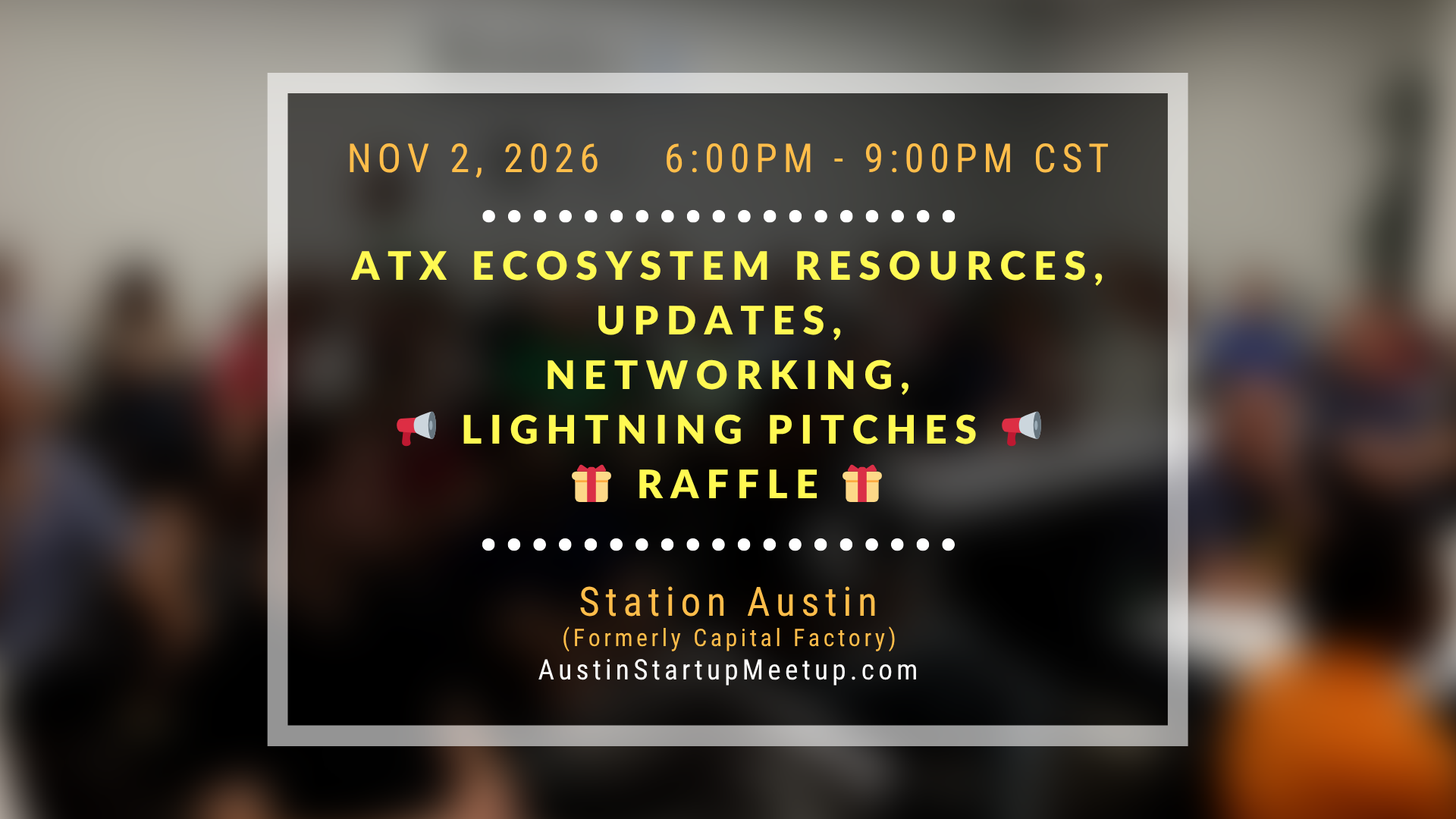
We have a great RSVP list for the Austin Startup Meetup event this month. We will bring founders, operators, investors, and ecosystem builders together for a practical night of startup updates, networking, lightning pitches, and community resources.
Each meetup is designed to make Austin's startup ecosystem easier to navigate. We share what is happening across the market, highlight useful local resources, give founders a lightweight way to pitch or ask for help, and create space for real conversations before and after the formal program.
🛠️ ATX Ecosystem Updates & Resources
In this month's ecosystem segment, we will cover the latest funding trends, local startup news, useful founder resources, and upcoming events across Austin. The goal is to give you a quick but useful view of what has changed since the last meetup and what to pay attention to over the next month.
📢 Lightning Pitches & Shoutouts
Then we'll get right into the most exciting part of the event. We'll welcome members from the audience to come and give lightning pitches on their startups, projects and ideas. We want entrepreneurs to come out of their comfort zone and talk about their ideas, challenges, wants and needs in an open forum of helpful members in the community. If you are launching, hiring, fundraising, looking for customers, or sharing a resource for founders, this is your chance to get on the room's radar.
🎁 Exclusive Raffle!
After that, we will give away a 100% FREE personal subscription that can be used with any JetBrains product of their choice.
- 📍 Voltron (1st Floor) @ Station Austin (Formerly Capital Factory)
- 🕝 November 2, 2026 6pm-9pm CST
- 🔗 Event details and RSVP for future events here.
- 💻 Get the event presentation slides here.
Here's the slide deck for the event
Here's a list of everyone who pitched at the event
Sponsors
- Founderdash: FounderDash is your AI co-founder. It researches your idea live, then builds the deliverables you’d pay consultants for - a cited market report, an investor pitch deck, a financial model, and a growth model. Editable, exportable, and grounded in real sources.
- Buildbonnet Web Studios: Buildbonnet is an Austin-based design and development agency creating tailored software solutions for startups and enterprises. Fill out the form on the website and mention “Austin Startup Meetup” in your inquiry for a chance to receive a free UI, UX, or product consultation.
- Aidiyoh: Aidiyoh is a 24/7 AI music radio platform where listeners can discover AI-generated and AI-assisted music, and creators can upload their own tracks and launch a radio station. You can now also create instant lyric videos for your songs.
State of the Startup Ecosystem
The central venture-market story remains concentration. Capital is available at remarkable scale for companies with strong technical differentiation, infrastructure leverage, and credible paths to category leadership. At the same time, most founders still face a selective market in which customer proof, distribution, margins, security, and execution matter more than a broad narrative about AI.
Global Trends
Global venture funding reached $159 billion in the third quarter of 2026 across nearly 6,000 startups, according to Crunchbase. Q3 was down 25% from the second quarter but remained 53% above Q3 2025. Through the first nine months of the year, global venture investment reached $679 billion, the strongest first three quarters on record.
Capital concentration reached a new high. A record 27 companies raised rounds of at least $1 billion during Q3, and AI companies captured $102 billion, or 64% of all global venture funding for the quarter. Aerospace, robotics, data centers, semiconductors, and energy each attracted at least $10 billion, showing how quickly investment is moving from model development into the physical and technical systems that support AI.
October extended that pattern. AI-compute company Tenstorrent raised a $1.5 billion Series E at a $6.2 billion post-money valuation. AI infrastructure platform Modal raised a $750 million Series D at a $15.75 billion post-money valuation. Cloud and AI security company Upwind raised a $400 million Series C at a $3.8 billion valuation.
The lesson is not that every AI company can raise easily. It is that investors are willing to fund infrastructure, security, compute, and applied systems at significant scale when growth, technical depth, and market demand reinforce one another.
U.S. Ecosystem
U.S.-based startups raised $91 billion in Q3, representing about 57% of global venture investment. The San Francisco Bay Area still accounted for nearly one-quarter of global funding, but Austin, New York, Boston, Los Angeles, Seattle, and other ecosystems continue to win in specific sectors.
October's largest U.S. rounds showed how the market is rewarding the layers around AI. Tenstorrent is scaling manufacturing and commercial deployment for open AI compute. Modal is building the developer infrastructure used to train and run AI applications. Upwind is securing increasingly complex cloud environments and AI workloads.
The exit market is improving selectively as well. Strategic buyers are pursuing companies that add defensible technology, regulated products, or specialized customer relationships. Austin's October acquisition activity in rare-disease therapeutics, fertility technology, radiation-hardened semiconductors, and industrial AI fits that broader pattern.
For early-stage founders, the market remains more demanding than the headline numbers suggest. Investors are still asking whether a company has a durable advantage, a credible route to customers, and a business model that improves as the product scales.
Texas
Texas entered November with momentum on both sides of the capital market. Austin companies announced at least $439 million across four equity rounds in October, while Dallas-based Disruptive raised a $10 billion flagship growth-equity fund focused on later-stage companies in AI, defense, and software.
The state's sector mix continues to be a competitive advantage. Texas companies are building at the intersection of software and difficult real-world systems: energy, aerospace, defense, semiconductors, construction, healthcare, logistics, financial services, manufacturing, and data infrastructure.
The new capital does not remove the need for discipline. It does, however, expand the regional network of investors, customers, technical talent, and strategic buyers available to companies across Austin, Dallas-Fort Worth, Houston, and San Antonio.
Austin
Austin's October activity was notable for both scale and breadth. Four disclosed equity rounds totaled at least $439 million, and acquisition agreements involving two local life-sciences companies carried a combined potential value of more than $3.3 billion.
- Construction technology: ICON raised a $200 million Series D, co-led by Baillie Gifford and funds managed by BlackRock, to manufacture and deploy its robotic construction systems, expand into new markets, and open a large-scale Austin R&D facility.
- Housing finance: Homeward raised $120 million in Series D equity led by Saluda Grade. The company also secured $330 million in asset-backed debt facilities to expand its cash-offer and bridge-financing products; that debt capacity is separate from the equity round.
- Open-source AI: Nous Research raised $90 million to expand its Hermes AI agent and move further into enterprise workflows. The round valued the company at $1.5 billion.
- Enterprise AI: RapidCanvas raised a $29 million Series B led by Vertex Ventures SEA & India, bringing its reported total funding to $52.5 million. The company then acquired Austin industrial aftermarket software company Entytle; financial terms were not disclosed.
- Life-sciences M&A: Shionogi agreed to acquire Austin-based IntraBio for $2 billion in upfront cash, subject to closing conditions and regulatory approvals. Ferring signed an agreement to acquire fertility biotech Gameto for up to $1.3825 billion, with that ceiling dependent on development, regulatory, and commercial milestones.
- Semiconductors: Microchip Technology acquired Austin-based VORAGO Technologies, adding radiation-hardened and radiation-tolerant processors for aerospace, defense, space, and industrial applications. Terms were not disclosed.
- Neurotechnology: Phantom Neuro implanted its muscle-machine interface in human patients for the first time, advancing a less-invasive system designed to help people control prosthetic limbs.
The broader signal is that Austin now has more companies operating at the boundary between software and the physical world. Robotics, construction, semiconductors, healthcare, industrial operations, and housing finance all require deep domain knowledge in addition to strong technology.
Notable Funding, Launch, and M&A Stories
Here are several October 2026 stories worth tracking:
- ICON raised a $200 million Series D to scale its Titan multi-story robotic construction system, expand manufacturing, and open a large Austin research facility.
- Homeward raised $120 million in Series D equity and secured $330 million in asset-backed debt facilities to expand cash-offer and bridge-financing products for real estate agents and their clients.
- Nous Research raised $90 million at a $1.5 billion valuation and launched Hermes for Businesses, extending its open-source AI agent into private enterprise workflows.
- RapidCanvas raised a $29 million Series B to expand its managed enterprise AI platform and field AI engineering model.
- RapidCanvas acquired Entytle, adding industrial aftermarket data, customers, and domain expertise to its AI platform. Financial terms were not disclosed.
- Shionogi signed an agreement to acquire IntraBio for $2 billion in upfront cash. The proposed transaction remains subject to customary closing conditions and regulatory approvals.
- Ferring signed an agreement to acquire Gameto for up to $1.3825 billion. The headline figure is a milestone-based ceiling, not cash already paid, and the transaction has not yet closed.
- Microchip Technology acquired VORAGO Technologies to strengthen its portfolio of radiation-hardened microcontrollers and processors for space, defense, and industrial systems. Terms were not disclosed.
- Phantom Neuro implanted its muscle-machine interface in humans for the first time, moving its prosthetic-control technology into a first-in-human clinical study.
- Tenstorrent raised a $1.5 billion Series E to scale manufacturing and deployment of its AI chips, servers, and licensable compute architecture.
- Modal raised a $750 million Series D and Upwind raised a $400 million Series C, reinforcing investor demand for AI infrastructure and security.
- Dallas-based Disruptive raised a $10 billion flagship fund for concentrated growth investments in AI, defense, and software companies.
What Founders and Investors Should Do Now
For Founders
- Build toward strategic value, not just the next financing. Austin's October acquisitions show that specialized technology, regulatory progress, customer relationships, and domain expertise can create multiple paths to liquidity.
- Separate every form of capital in your story. Equity, debt facilities, grants, contracts, and milestone-based acquisition payments carry different risks and should not be blended into one headline number.
- Prove that AI improves an outcome. Investors and customers increasingly want evidence that the product reduces cost, increases revenue, improves reliability, or unlocks a workflow that was previously impractical.
- Use Austin's domain networks. The region offers unusually direct access to operators in construction, healthcare, energy, defense, semiconductors, financial services, real estate, and manufacturing.
- Start year-end planning now. Decide which customer, hiring, financing, and product milestones must be completed before the holiday slowdown and which conversations should begin before 2027 budgets are finalized.
For Investors
- Look for companies that own a hard layer of the stack. Compute, security, robotics, regulated therapeutics, specialized hardware, and proprietary workflow data can support more durable advantages than a thin application layer.
- Evaluate financing quality, not just financing size. Debt capacity, customer concentration, capital intensity, milestone obligations, and investor terms all affect the real strength of a round.
- Treat acquisition announcements precisely. Distinguish signed agreements from completed transactions and separate upfront consideration from contingent milestone payments.
- Follow the statewide capital network. Austin's company formation and technical talent are increasingly connected to growth investors in Dallas, industrial and energy customers in Houston, and defense and healthcare capabilities across Texas.
- Pay attention to commercialization milestones. First-in-human studies, manufacturing deployments, regulated approvals, and enterprise rollouts can be more informative than another product announcement.
Upcoming Events
There are several events for startups and builders to look forward to in Austin over the next 90 days.
- Nov 6-7: Texas Linux Fest: Texas Linux Fest is the first state-wide annual community-run conference for Linux and open source software users and enthusiasts from around the Lone Star State.
- Nov 9-12: Conference on Robot Learning: An international research conference at the intersection of robotics and machine learning, with three main conference days followed by workshops on November 12.
- Nov 12: Austin MedTech Connect Summit: A full-day gathering for healthtech founders, clinicians, investors, and industry leaders, including founder quickfires, investor discussions, and the Austin Life Science Innovation Awards.
- Nov 12-13: SpiceWorld 2026: SpiceWorld is not your average tech conference. From sysadmins, help desk heroes, and network engineers keeping the lights on, to cybersecurity pros, IT directors, and CIOs mapping out the future, SpiceWorld brings the whole team and tech stack together.
- Nov 17-18: MLOps World | GenAI Summit: Two days of case studies, workshops, and technical sessions focused on taking machine learning, generative AI, and agentic systems from experiments into production.
- Dec 8-9: FTT Fintech Festival North America: A financial-technology conference at the JW Marriott Austin covering AI in financial services, payments, embedded finance, digital identity, fraud, and the next generation of financial infrastructure.
Large events are fun, but do not discount the power and personal nature of local meetups that can be as good or even more fulfilling. Here are some that you should know about:
- November 2: Austin Startup Meetup - Austin Startup Meetup is the place to be for founders, advisors, mentors, investors, institutions, and anyone connected to Austin’s startup community. Come for the conversations, pitches, introductions, and networking. Leave with new connections, fresh ideas, valuable insights - and hopefully a smile.
- November 4: Sovereign AI Club Austin: Local AI & Open Models - a discussion-focused meetup covering local models, open-source AI, privacy, security, and user control.
- November 5: Entreprenista Local Meetup in Austin - an in-person gathering for women founders and business owners focused on peer connections, collaboration, and growth.
- November 6: Austin Business Owners AI Mastermind - a curated session for founders, operators, and business owners applying AI to marketing, sales, operations, and team workflows.
- November 8: The AI Implementation Club - a hands-on build session at Antler for founders and operators working on practical AI projects.
- November 9: Physical AI Data & Simulation Infrastructure Happy Hour - a CoRL-week gathering for robotics researchers, founders, engineers, and investors working on physical AI systems.
- November 11: Physical AI Night: As robotics research & deployment speed up, join CRV, LanceDB, and Orchestral Labs for a Physical AI Night during CoRL.Hang out with researchers, founders, and engineers working on robots in the real world, with drinks, (competitive) shuffleboard, and good conversation.
- November 12: Austin MedTech Connect Summit - a full-day event where Central Texas health innovation meets founders, clinicians, customers, and capital.
Conclusion
October showed Austin operating across the full startup lifecycle. Local companies raised growth capital, launched enterprise products, completed acquisitions, entered clinical studies, and became acquisition targets themselves. That breadth matters more than any single headline because it demonstrates that Austin can support companies from formation through scale and strategic exit.
The market is still selective. Large checks are flowing toward teams that combine technical depth with clear demand, and strategic buyers are looking for assets that would be difficult to build internally. For Austin founders, the opportunity is to turn the city's sector expertise and operating talent into products that solve consequential problems.
You do not need to wonder where to meet some of the brightest minds building the next layer of Austin's startup ecosystem. Austin Startup Meetup brings them together so you can focus on making meaningful connections and discovering the people shaping the future.