
July 2026: Austin Startup Ecosystem Update + Event Details
June 2026 showed Austin is well-positioned as capital flows into AI, defense, chips, robotics, energy, infrastructure, health, and practical enterprise software. #AustinStartups #ATXTech



June 2026 showed that the startup market is still active, but the bar keeps rising. Capital is flowing into AI, defense, physical infrastructure, robotics, chips, health, and real-world automation, while investors are asking harder questions about revenue quality, gross margins, customer proof, security, and whether a company has a durable advantage beyond a good demo.
For Austin, this is an important moment. The city sits close to several of the categories investors care about most right now: AI, defense, chips, robotics, energy, infrastructure, cybersecurity, health, developer tools, and practical enterprise software. Texas is also becoming more connected as a statewide innovation market, which gives Austin founders more ways to find customers, partners, talent, and capital across Dallas-Fort Worth, Houston, San Antonio, and the broader region.
Featured Event: Austin Startup Meetup
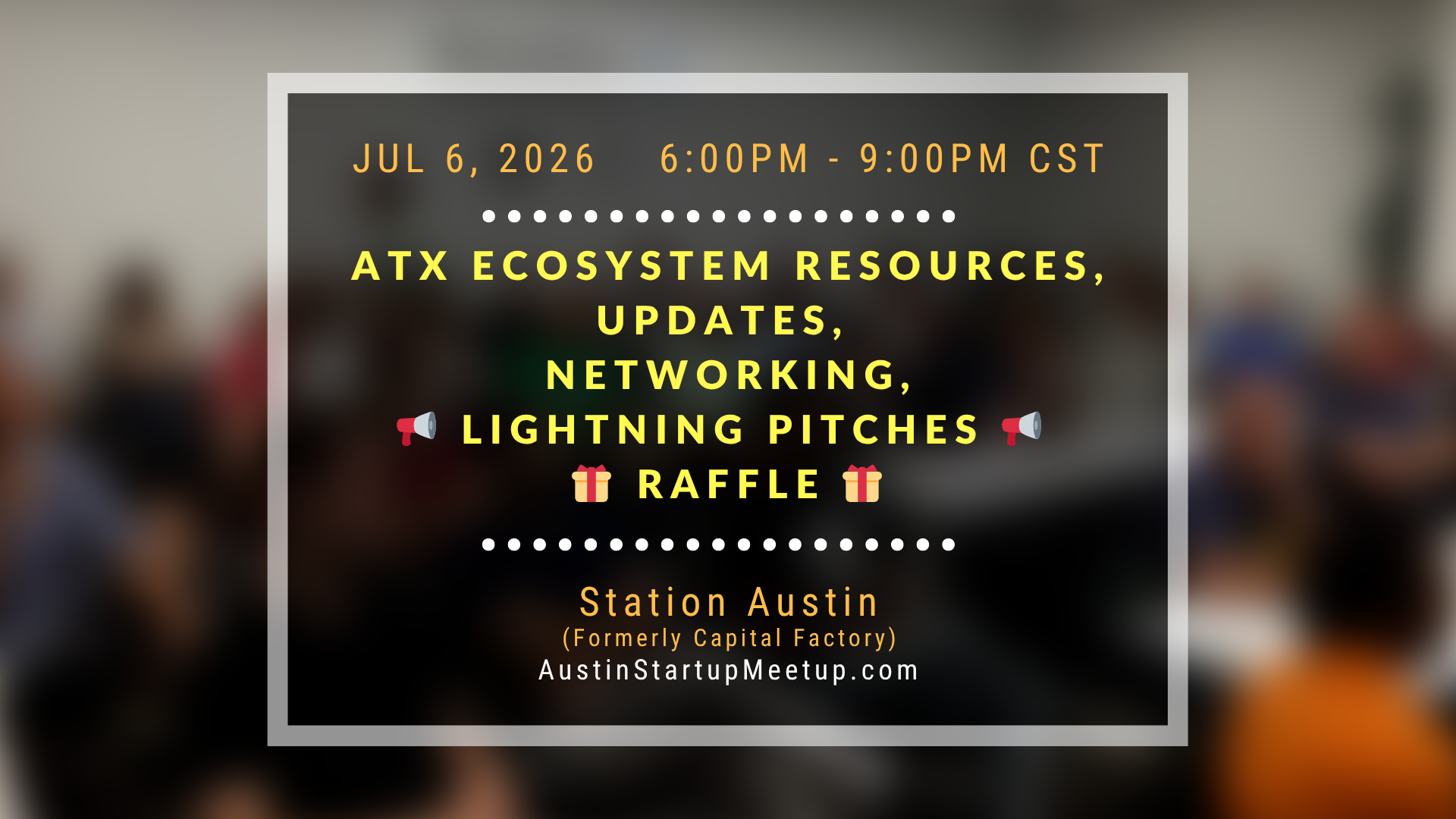
We have a great RSVP list for the Austin Startup Meetup event this July. Looking forward to see passionate founders share the exciting projects they're working on.
🛠️ ATX Ecosystem Updates & Resources
As usual, we'll start by taking a quick look at the state of the Austin startup ecosystem, talk about some news and upcoming events and provide startup resources.
📢 Lightning Pitches & Shoutouts
Then we'll get right into the most exciting part of the event. We'll welcome members from the audience to come and give lightning pitches on their startups, projects and ideas. We want entrepreneurs to come out of their comfort zone and talk about their ideas, challenges, wants and needs in an open forum of helpful members in the community.
🎁 Exclusive Raffle!
After that, we will give away a 100% FREE personal subscription that can be used with any JetBrains product of their choice.
- 📍 Voltron (1st Floor) @ Station Austin (Formerly Capital Factory)
- 🕝 July 6, 2026 6pm-9pm CST
- 🔗 Event details and RSVP for future events here.
- 💻 Get the event presentation slides here.
Here's the slide deck for the event (Updated AFTER the event)!
Here's a list of everyone who pitched at the event (Updated AFTER the event)!
Sponsors
- Aidiyoh: Aidiyoh is a 24/7 AI music radio platform where listeners can discover AI-generated and AI-assisted music, and creators can upload their own tracks and launch a radio station. You can now also create instant lyric videos for your songs.
- Buildbonnet Web Studios: Buildbonnet is an Austin-based design and development agency creating tailored software solutions for startups and enterprises. Fill out the form on the website and mention “Austin Startup Meetup” in your inquiry for a chance to receive a free UI, UX, or product consultation.
State of the Startup Ecosystem
June 2026 made the startup market look strong from a distance and much more selective up close.
The headline numbers are big because AI, defense, robotics, infrastructure, and a smaller number of high-conviction companies are pulling in a large share of the capital. But the broader market is not easy. Founders still need real customers, clear revenue quality, disciplined burn, and a strong explanation for why their company gets more defensible over time.
Below is a condensed look at the startup ecosystem in June 2026, from the global market to the U.S., Texas, and Austin.
Global Trends: AI, Defense, and Physical Infrastructure Keep Pulling Capital
Globally, the market is being shaped by a simple pattern: capital is available, but it is concentrated.
- AI remains the biggest magnet. The largest rounds continue to go to companies building foundation models, AI infrastructure, developer tools, agent platforms, robotics, security, chips, data center infrastructure, and industry-specific AI systems. But investors are now more skeptical of generic AI wrappers. The question has shifted from "Do you use AI?" to "Do you own a workflow, a dataset, a distribution channel, or an operating advantage that will still matter when the models improve?"
- Defense tech is also becoming a mainstream venture category. The Financial Times reported that defense technology startups raised $12.3 billion in the first half of 2026, nearly twice the amount raised during the same period last year, as drones, autonomous systems, battlefield AI, maritime systems, and resilient supply chains became urgent priorities.
- Physical AI is another important theme. Venture investors are paying more attention to companies that bring AI into the real world: robots, drones, factories, logistics networks, vehicles, sensors, security systems, warehouses, and industrial environments. This matters because software alone is no longer the only place where fast-growing technology companies are being built.
- Europe is also showing strength. U.K. startups reportedly raised $17 billion in the first half of 2026, with AI companies accounting for nearly three quarters of that total. That reinforces the broader global pattern: AI is lifting funding totals, but much of the money is going into a narrow set of companies and sectors.
The U.S. Ecosystem: Big Rounds, High Valuations, Higher Standards
The U.S. startup market is active, but uneven.
Large funds are still being raised, and many investors remain excited about early-stage companies. B Capital closed a $500 million early-stage fund at the end of June, with a focus on seed and Series A companies in areas including robotics, defense tech, and space infrastructure. But the same story also points to the challenge founders face: early-stage valuations have risen, competition for the best companies is intense, and investors are trying to stay disciplined.
For founders, the practical message is clear:
- AI can help create urgency, but it no longer carries the whole pitch.
- Investors want proof that customers will pay, renew, and expand.
- Infrastructure costs matter, especially for AI-native products.
- Security, compliance, reliability, and data rights are becoming core product questions.
- Hard tech, defense, robotics, chips, and physical-world automation are gaining attention, but they also require more operational discipline.
Some notable June stories reflect the market's direction.
- Coram AI raised $35 million to turn existing security cameras, badge systems, and emergency workflows into AI-powered physical security tools.
- General Intuition raised $320 million for AI work backed by investors including Khosla Ventures, General Catalyst, and Jeff Bezos.
- Hang Ten Systems, founded by former Infosys CEO Vishal Sikka, raised $32 million in seed funding.
These are all different companies, but they point to the same larger trend: investors want AI that is tied to serious workflows, technical depth, or real-world deployment.
Texas: Statewide Strength Is Becoming More Useful
Texas continues to look less like a collection of separate startup cities and more like a connected innovation economy.
Austin, Dallas-Fort Worth, Houston, and San Antonio each bring different strengths. Austin has founder density, software talent, AI activity, defense innovation, data, consumer startups, and community energy. Dallas-Fort Worth has enterprise customers, logistics, fintech, corporate buyers, aerospace, and a large business base. Houston has energy, space, health, climate, industrial technology, and deep corporate relationships. San Antonio has cybersecurity, healthcare, military, and applied technology strengths.
That matters because many of the strongest startup categories in 2026 are not pure software categories. AI infrastructure needs power, land, cooling, data centers, chips, and skilled labor. Defense startups need government relationships and testing pathways. Energy and industrial startups need customers and physical infrastructure. Health and robotics companies need regulated environments, operational expertise, and deployment partners.
For Texas founders, the opportunity is to think statewide:
- An Austin AI company may find enterprise customers in Dallas.
- A robotics or energy startup may find partners in Houston.
- A cybersecurity or defense startup may find relationships in San Antonio.
- A chip, manufacturing, or infrastructure company may benefit from Central Texas facilities and talent.
The better connected these markets become, the more Texas can compete as a complete startup platform rather than a single-city ecosystem.
Austin: From Software Hub to Real-World Technology Market
Austin had a strong June because the city's strengths align with the categories investors are watching.
One of the clearest local signals was the rebrand and Texas expansion of Fab2, formerly Atomic Semi. The company, founded by chip architect Jim Keller and Sam Zeloof, is now headquartered in a 120,000-square-foot Austin facility and is building compact, software-defined semiconductor fabrication systems. Fab2 also operates a "fab fab" in Lockhart and has raised $15 million in seed funding led by the OpenAI Startup Fund.
That story matters because it is not just another software startup. It sits at the intersection of chips, advanced manufacturing, AI infrastructure, and U.S. industrial capacity. Those are exactly the categories gaining more attention nationally.
Austin is also becoming more interesting for drone and physical-world automation. Zipline announced in June that it plans to expand autonomous drone delivery into Austin later in 2026, after operating in Dallas and Houston. Zipline is not an Austin startup, but its move into the city is a useful signal: Austin is increasingly becoming a deployment market for advanced technology, not just a place where software companies are headquartered.
The broader point for Austin founders is that the city has room to play in both software and physical-world technology:
- AI and developer tools
- Defense and dual-use technology
- Chips and semiconductor infrastructure
- Robotics, drones, and physical AI
- Cybersecurity and data infrastructure
- Health, wellness, diagnostics, and care delivery
- Energy, climate, and industrial software
- Startup services, founder communities, and operator networks
Austin's practical founder culture is useful in this market. The current environment rewards founders who can sell, ship, learn quickly, and show evidence. That fits Austin well.
Notable Funding, Launch, and M&A Stories
Here are some notable June stories that reflect the broader market.
- Fab2, formerly Atomic Semi, expanded its center of gravity to Austin and Lockhart. The company is building compact semiconductor fabs and is now headquartered in Austin, with a 30,000-square-foot facility in Lockhart. Why it matters: chips, advanced manufacturing, and AI infrastructure are becoming more strategically important, and Central Texas is part of that story.
- Zipline announced plans to expand into Austin later in 2026. The autonomous drone delivery company has already operated in Dallas and Houston and plans to bring drone delivery to Austin. Why it matters: physical automation is moving from demos to real consumer and logistics deployment.
- Coram AI raised $35 million. Coram connects cameras, badge readers, visitor logs, and emergency systems so organizations can detect and respond to incidents faster. Why it matters: physical AI is becoming a serious venture category, especially when it connects to security, facilities, schools, and operational workflows.
- General Intuition raised $320 million. The AI startup's round was backed by major investors including Khosla Ventures, General Catalyst, and Jeff Bezos. Why it matters: investors are still willing to fund ambitious AI companies when they believe the technical ceiling is high.
- Hang Ten Systems raised $32 million in seed funding. The new AI company from former Infosys CEO Vishal Sikka was backed by Mayfield. Why it matters: experienced technical founders with deep enterprise and AI credibility can still raise quickly in a selective market.
- Quantum Systems raised at an $8 billion valuation. The German drone maker's large round, reported shortly after June, reflects the continued investor focus on defense, autonomous systems, and allied industrial capacity. Why it matters: the defense tech boom is global, and it is pulling capital into drones, autonomy, manufacturing, and battlefield intelligence.
What Founders and Investors Should Do Now
The message for founders in July 2026 is clear: there is still plenty of opportunity, but the market rewards substance.
Build around a real customer pain
The strongest pitch is not "we use AI." It is:
- What painful workflow are you improving?
- Who pays for it?
- How often do they use it?
- How much time, money, risk, or labor do you remove?
- Why do you get more valuable as you scale?
Show proof earlier
In this market, a small number of serious customers is better than a large number of vague conversations. Founders should prioritize paid pilots, letters of intent, usage data, design partners, retention signals, and clear before-and-after outcomes.
Know your infrastructure costs
For AI companies, gross margin matters earlier than it used to. Founders need to understand model costs, inference costs, data storage, cloud usage, human review, security, compliance, and how margins improve over time.
Use Austin and Texas deliberately
Austin founders should not think only in local terms. The rest of Texas can be a strategic advantage. Look for customers, pilots, investors, universities, industrial partners, policy relationships, and enterprise buyers across the state.
Build defensibility beyond the demo
Investors are looking for proprietary data, workflow ownership, distribution, technical depth, regulatory expertise, operational know-how, customer relationships, or physical infrastructure advantages. If a competitor can copy the demo in a weekend, the company needs a stronger moat.
Upcoming Events
There are several events for startups and builders to look forward to in Austin over the next 90 days.
- Jul 27-30: HI-TEC: Supported by the National Science Foundation’s Advanced Technological Education (NSF ATE) program, HI-TEC is a national conference on advanced technological education where secondary and postsecondary educators, counselors, industry professionals, trade organizations, and technicians can update their knowledge and skills. Charged with preparing America’s skilled technical workforce, the event focuses on the preparation needed by the existing and future workforce for companies in the high-tech sectors that drive our nation’s economy.
- Aug 31 - Sep 2: Airflow Summit: Airflow Summit is the annual conference for the worldwide community of Apache Airflow users and contributors. This conference is a celebration of the people who make Airflow what it is. The conference brings together the brightest minds in workflow orchestration. Expect insightful talks, hands-on workshops, and plenty of opportunities to meet and collaborate with fellow Airflow enthusiasts. Whether you’re contributing code, shaping best practices, or just starting your Airflow journey, this event is for you.
- Sep 23-24: Rails World 2026: Rails World is a two-day, two track community conference featuring technical talks, demos, networking, and keynotes about the latest features and best practices in Rails development.
- Oct 26-30: Austin Tech Week: Austin Tech Week is a five day celebration, uniting the brightest minds in Austin’s tech ecosystem. For over a decade, this annual event has drawn thousands of local entrepreneurs, tech leaders, and friends together to connect, learn, and maximize business impact.
- Nov 6-7: Texas Linux Fest: Texas Linux Fest is the first state-wide annual community-run conference for Linux and open source software users and enthusiasts from around the Lone Star State.
- Nov 12-13: SpiceWorld 2026: SpiceWorld is not your average tech conference. From sysadmins, help desk heroes, and network engineers keeping the lights on, to cybersecurity pros, IT directors, and CIOs mapping out the future, SpiceWorld brings the whole team and tech stack together.
Large events are fun, but do not discount the power and personal nature of local meetups that can be as good or even more fulfilling. Here are some local meetups and events startup and business folks should know about:
- July 7, 6:30 PM - 8:30 PM: The Health Hustlers: An Exclusive Networking Event for Health/Wellness Professionals: An evening of meaningful connection and collaboration for anyone who works in the health, wellness, or fitness space here in Austin. Whether you’re part of a wellness-focused business, contribute to a health-oriented team, or simply play an active role in helping others improve their well-being, this event is for you. Health Hustlers ATX is a space to build real relationships with people who understand your passion for helping others live better, healthier lives.
- July 8, 8:00 AM - 10:00 AM: Beans & Builders Founder Meetup at Cosmic Pickle. A relaxed Austin Founders Feed meetup where local founders connect over coffee and talk through marketing, growth, product, systems, AI, and funding.
- July 13, 6:00 PM - 8:00 PM: Austin | Claude Code Meetup at Capital Factory. Local builders will share projects created with Claude Code, followed by breakout sessions for the community.
- July 16, 5:00 PM - 7:00 PM: LAUNCH PAD at STATION Austin. A pitch and networking event for founders, builders, investors, and innovation leaders, with rapid-fire pitches and prizes.
- July 17, 8:30 AM - 10:30 AM: Austin Female Founders & Friends at Cosmic Saltillo. A quarterly coffee meetup from The Artemis Fund for Austin's female founder community and people who can benefit from that network.
- July 17-19: AITX Community x NVIDIA Claw Agent Hackathon at Antler VC. A technical builder event focused on real autonomous agent applications, tool use, workflow automation, and live demos.
Conclusion
June 2026 showed a startup ecosystem that is strong, but selective. Capital is still moving. AI remains the center of gravity. Defense, physical AI, chips, infrastructure, health, energy, and industrial technology are becoming more important. But founders now need more than a good story. They need customer evidence, sharper execution, stronger business fundamentals, and a clear reason why their company can win.
For Austin, this is a moment to lean in. The city has the talent, community, capital, and industry alignment to build important companies in this next cycle. But no one builds alone.
That is why Austin Startup Meetup exists: to bring together founders, builders, investors, operators, mentors, and startup supporters who are actively shaping what comes next. Whether you are working on your first idea, scaling a company, investing in startups, advising founders, or simply trying to understand where the market is going, this is the right time to stay connected to the Austin startup community.