
June 2026: Austin Startup Ecosystem Update + Event Details
May 2026 showed a startup market that is active but more selective. AI, deep tech, defense, infrastructure, and health remain strong, while Austin and Texas continue gaining momentum. #AustinStartups #ATXTech



May 2026 showed that the startup ecosystem is still full of opportunity, but the market is becoming far more selective. Capital continues to flow into AI, deep tech, defense, infrastructure, health, and other high-conviction sectors, while investors push founders for stronger execution, clearer customer demand, and better fundamentals. For Austin, this is an important moment as the city gains global recognition, Texas becomes more coordinated as an innovation economy, and Central Texas aligns with many of the categories investors care about most.
Featured Event: Austin Startup Meetup
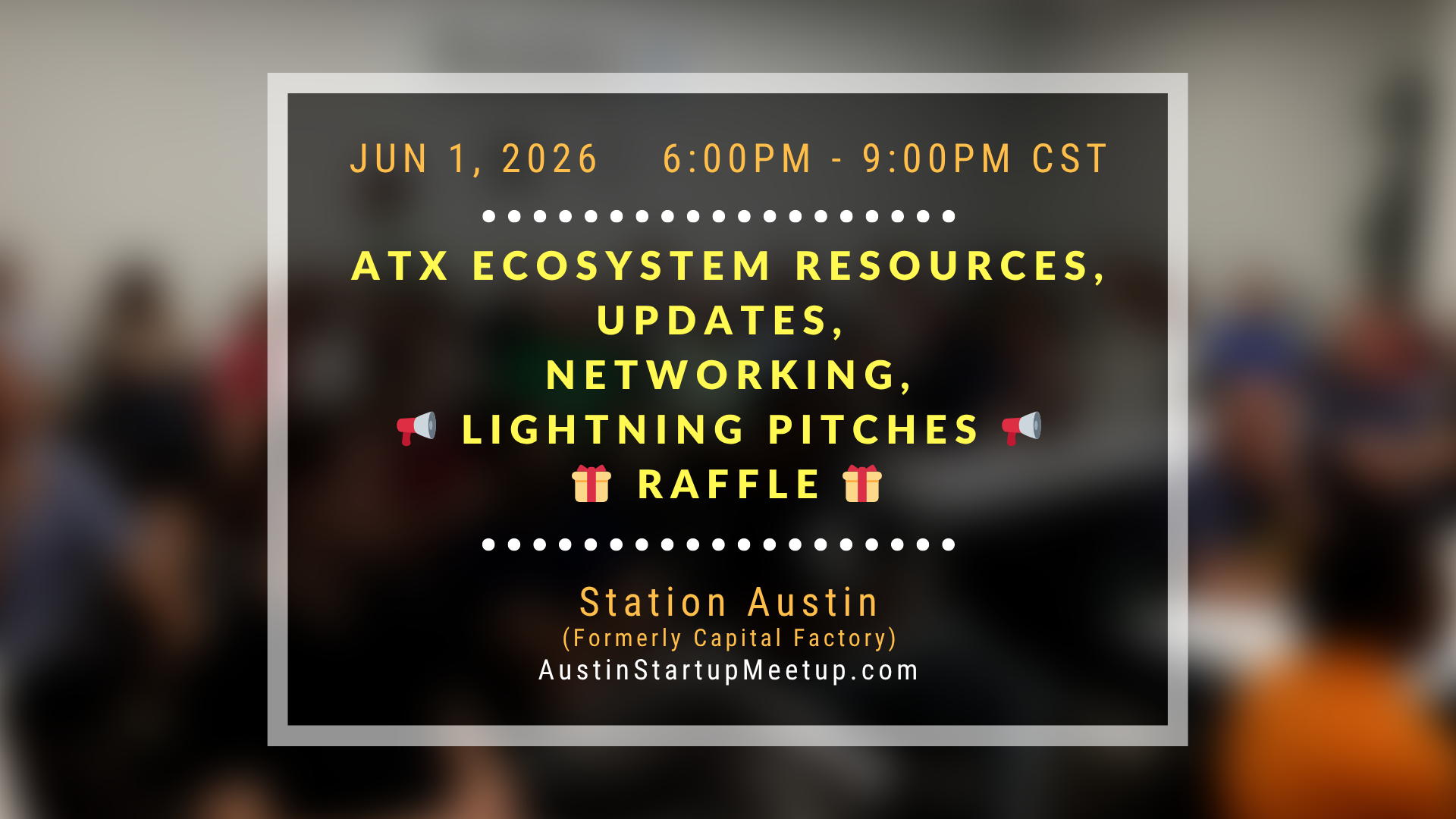
We have a great RSVP list for the Austin Startup Meetup event this August. Looking forward to see passionate founders share the exciting projects they're working on.
🛠️ ATX Ecosystem Updates & Resources
As usual, we'll start by taking a quick look at the state of the Austin startup ecosystem, talk about some news and upcoming events and provide startup resources.
📢 Lightning Pitches & Shoutouts
Then we'll get right into the most exciting part of the event. We'll welcome members from the audience to come and give lightning pitches on their startups, projects and ideas. We want entrepreneurs to come out of their comfort zone and talk about their ideas, challenges, wants and needs in an open forum of helpful members in the community.
🎁 Exclusive Raffle!
After that, we will give away a 100% FREE personal subscription that can be used with any JetBrains product of their choice.
- 📍 Voltron (1st Floor) @ Station Austin (Formerly Capital Factory)
- 🕝 June 1st, 2026 6pm-9pm CST
- 🔗 Event details and RSVP for future events here.
- 💻 Get the event presentation slides here.
Here's the slide deck for the event (Updated AFTER the event)!
Here's a list of everyone who pitched at the event (Updated AFTER the event)!
Sponsors
- Aidiyoh: Aidiyoh is a 24/7 AI music radio platform where listeners can discover AI-generated and AI-assisted music, and creators can upload their own tracks and launch a radio station. You can now also create instant lyric videos for your songs.
- Buildbonnet Web Studios: Buildbonnet is an Austin-based design and development agency creating tailored software solutions for startups and enterprises. Fill out the form on the website and mention “Austin Startup Meetup” in your inquiry for a chance to receive a free UI, UX, or product consultation.
State of the Startup Ecosystem
May 2026 offered a clear message to founders: the startup ecosystem is not slowing down, but it is becoming far more selective.
Capital is still moving. AI is still attracting enormous investor attention. Deep tech, defense, infrastructure, healthcare, fintech, and climate-related innovation remain active. But the market has shifted away from broad hype and toward sharper execution, stronger fundamentals, and clear real-world deployment.
For Austin founders, this is both a challenge and an opportunity. The national market is more concentrated, but Austin continues to benefit from its growing position in AI, defense, physical infrastructure, enterprise software, health, energy, and hard tech.
Below is a condensed look at the startup ecosystem in May 2026, from the global market to the U.S., Texas, and Austin.
Global Trends: Selective Growth, Not Easy Growth
Globally, May 2026 showed a startup market that is still active, but no longer evenly distributed.
The biggest theme is concentration. Capital is flowing heavily into a smaller number of companies, sectors, and regions. AI-native companies, deep tech, defense, climate, enterprise infrastructure, and industrial technology continue to attract investor interest, while many consumer and generic software plays face a tougher path.
Key Global Themes
- AI is still the center of gravity: AI remains the dominant force in venture capital. Large foundation model companies, AI infrastructure providers, agent platforms, developer tools, and compute-adjacent startups are absorbing a major share of investor attention.
- Investors are looking for defensibility: The “AI wrapper” story is getting weaker. Founders now need to explain what makes their company durable: proprietary data, workflow ownership, distribution advantages, regulatory expertise, embedded customer relationships, or hard-to-replicate infrastructure.
- Deep tech and physical infrastructure are gaining momentum: As software becomes easier to build, investors are paying more attention to harder categories: robotics, chips, advanced manufacturing, energy systems, space, defense, logistics, and data center infrastructure.
- Europe is becoming more strategically important: Government-backed capital, sovereign technology priorities, energy security, defense, and industrial policy are helping Europe gain strength in deep tech and strategic autonomy.
- Startup hubs are specializing: The global map is no longer only about “who has the most startups.” The strongest ecosystems are increasingly defined by specialization: AI in San Francisco, fintech in London and New York, defense and physical AI in Austin, climate and energy in several emerging hubs, and deep tech clusters across Europe and Asia.
The U.S. Ecosystem: Big Numbers, Uneven Reality
On paper, the U.S. venture market looks strong. But the real picture is more complicated.
Much of the capital is concentrated in a small number of mega-rounds, large funds, and AI-driven companies. For early-stage founders, especially those outside the hottest categories, fundraising remains difficult.
What changed in May
- Mega-deals are distorting the market: Large AI and infrastructure rounds make overall funding numbers look very strong. But when the biggest deals are removed, the broader fundraising market looks much more selective.
- The best companies can still raise quickly: Companies with strong growth, clear customer pull, and strategic relevance can still attract capital. But the bar is much higher than it was during the 2020–2021 boom.
- Investors are asking harder questions: Founders should expect more scrutiny around margins, inference costs, sales efficiency, customer retention, pricing power, compliance, and the ability to turn AI features into durable business value.
- Enterprise AI is shifting from novelty to workflow: Customers are no longer impressed by AI demos alone. They want AI that saves time, reduces costs, improves revenue, handles compliance, or automates painful work inside real business processes.
- Hard tech is getting more attention: Defense, robotics, advanced manufacturing, industrial AI, energy, and data center infrastructure are becoming more attractive as investors look for businesses with physical-world moats.
Texas: Moving Toward a More Unified Innovation Economy
Texas continued to build momentum in May 2026, not just as a collection of strong cities, but as a more coordinated statewide startup ecosystem.
One of the most notable developments was the announcement of the Texas Innovation Operating System, a statewide effort led by Texas Venture Alliance and The Founders Arena to better connect Austin, Dallas-Fort Worth, Houston, San Antonio, and other innovation centers across the state.
This matters because Texas has several strong but distinct startup markets:
- Austin has software, AI, defense, data, consumer, and startup community density.
- Dallas-Fort Worth has enterprise, logistics, financial services, aerospace, and corporate customers.
- Houston has energy, space, health, industrial, and climate-related innovation.
- San Antonio has cybersecurity, military, healthcare, and applied technology strengths.
If these ecosystems become more connected, Texas could become more than a strong state for startups. It could become a more complete innovation platform for founders who need talent, customers, capital, manufacturing capacity, policy support, and enterprise access.
Texas themes to watch
- Statewide collaboration is becoming more important: Founders should think beyond one city. A startup may be based in Austin but find customers in Houston, strategic partners in Dallas, and defense or cybersecurity relationships in San Antonio.
- Physical infrastructure is becoming a Texas advantage: AI requires data centers, power, cooling, land, chips, connectivity, and skilled labor. Texas is well positioned in many of those areas, though water, grid reliability, and local permitting will become increasingly important issues.
- Texas is becoming more attractive to hard tech founders: The combination of business-friendly policy, industrial land, energy infrastructure, universities, corporate customers, and talent migration gives Texas a strong foundation for startups that go beyond pure software.
Austin: From Startup City to Global Tech Powerhouse
Austin’s startup ecosystem had a strong May 2026. The city continues to benefit from its unique mix of software talent, founder density, capital access, enterprise customers, defense innovation, university research, and quality of life. Austin is no longer just a lower-cost alternative to the coasts. It is increasingly a primary market for building serious technology companies.
Why Austin is standing out
- Austin is strong in the categories investors care about now: AI, defense, data infrastructure, cybersecurity, health, industrial software, energy, robotics, and physical-world automation all fit well with Austin’s evolving strengths.
- The region is becoming infrastructure-heavy: The broader Austin area is seeing significant data center and industrial development, including major data center projects in the surrounding region. This reinforces Central Texas’ role in the AI infrastructure buildout.
- The startup community remains active and connected: Austin’s advantage is not only capital. It is the density of founders, operators, engineers, investors, mentors, accelerators, meetups, and service providers who help companies move faster.
- Austin has a practical founder culture: The current market rewards founders who can sell, execute, and adapt. Austin’s ecosystem has always had a more grounded, builder-oriented character, which may be especially valuable in this new environment.
Notable Funding and M&A Deals
Here are some notable funding and M&A stories from May and the surrounding period that reflect broader market trends.
- Austin-based Cedar Build, a proptech company using AI for urban land development and generative building design, reportedly raised a $22.2 million Series A in May 2026. The company previously raised seed funding in 2023.
- Why it matters: Cedar fits the broader trend of AI moving into real-world workflows. Instead of using AI only for content or productivity, Cedar applies it to land use, development, design, and real estate decision-making.
- Cedar Park-based Vida Global completed its IPO in May 2026, raising $15 million. The company describes itself as an AI Agent Operating System for enterprises and agencies, helping deploy AI agents across customer service, sales qualification, scheduling, and operations.
- Why it matters: Vida reflects the rise of agent infrastructure. The market is interested in companies that help businesses deploy, manage, and scale AI agents safely and consistently.
- Austin-based Literati, known for children’s book fairs and subscription book clubs, was acquired by Trustbridge Partners. The deal gives Literati additional backing as it scales its book fair platform nationally.
- Why it matters: Not every important Austin startup story is AI or defense. Literati shows that strong category execution, distribution, brand, and operational depth can still create meaningful outcomes.
- Function Health has been active in acquisitions, including Getlabs and SuppCo, building toward a more comprehensive preventive health and medical intelligence platform. The company previously announced a major Series B round and has continued expanding its platform across lab testing, imaging, at-home care, and supplement intelligence.
- Why it matters: Healthtech is moving toward integrated platforms that combine diagnostics, data, AI, logistics, and consumer experience.
- Gyde, an AI-native brokerage platform focused on insurance, health, and wealth, launched with $60 million in funding and has been actively acquiring agencies such as Avid Health, Benavest, and We Know Medicare.
- Why it matters: Gyde is an example of a growing model: acquire traditional service businesses, then improve them with proprietary software and AI. This “AI plus roll-up” strategy may become more common in fragmented industries.
- Austin-based Fields Good launched with $1.8 million in pre-seed funding led by Female Founders Fund. The company is building a functional cookie brand that combines nostalgic consumer packaged goods with wellness-oriented positioning.
- Why it matters: Even in an AI-heavy market, consumer brands can still attract funding when they combine strong founder-market fit, clear positioning, and a modern distribution strategy.
What Founders and Investors Should Do Now
The message for founders in May 2026 is clear: there is still opportunity, but the market is rewarding substance over story.
Here is what Austin founders and operators should focus on now.
Build for a real customer pain, not just an AI trend
AI is important, but “we use AI” is no longer a strategy. The stronger pitch is:
- What painful workflow are you improving?
- Who pays for it?
- How much time or money do you save?
- Why are you hard to replace?
- What proprietary advantage gets stronger over time?
The best AI startups will not look like AI demos. They will look like better businesses.
Know your unit economics earlier
Investors are asking about margins, customer acquisition cost, payback period, retention, expansion revenue, infrastructure costs, and pricing power much earlier than before.
For AI companies, this is especially important. If your product depends heavily on model usage, inference, storage, or compute, you need a clear answer for how gross margins improve over time.
Use Austin’s strengths
Austin founders should lean into the region’s advantages:
- AI and software talent
- Defense and dual-use technology
- Data infrastructure and physical AI
- Energy and climate-adjacent opportunities
- Healthcare and biotech activity
- Enterprise customers across Texas
- A strong founder and operator community
Austin’s advantage is not just that it has startups. It has the right mix of people, industries, capital, and infrastructure for the categories that are gaining investor attention.
Think Texas-wide, not Austin-only
The next phase of the Texas ecosystem may be more connected across cities. Founders should actively look for customers, capital, and partners across the state.
Austin may be the headquarters, but Houston, Dallas-Fort Worth, San Antonio, and other Texas markets can provide strategic advantages depending on the industry.
Get closer to customers
In a selective market, customer evidence matters more than pitch polish. Founders should prioritize:
- Paid pilots
- Design partners
- Revenue conversations
- Usage data
- Retention signals
- Procurement learning
- Customer testimonials
- Clear before-and-after outcomes
A small number of serious customers is more valuable than a large number of vague conversations.
Prepare for longer fundraising cycles
Even strong companies should expect fundraising to take longer unless they are in a top-tier category with exceptional traction. Founders should manage runway carefully, start investor conversations earlier, and avoid assuming that a hot sector alone will carry the round.
Operators should become AI-fluent
For operators, the opportunity is not just to use AI tools. It is to redesign workflows around them.
Every team should be asking:
- Which manual processes can be automated?
- Which internal workflows can become AI-assisted?
- Where can we reduce response times?
- Where can we improve customer experience?
- Where can we use data better?
- Where can AI help us do more without increasing headcount?
The companies that win will not simply add AI features. They will become more operationally efficient because of AI.
Upcoming Events
There are events for startups to look forward to in Austin.
- June 9-11: iPX 2026 Austin: iPX brings together creators, brands, and innovators redefining how partnerships drive growth. Discover fresh ideas, meet the people powering real success, and experience the energy that’s transforming the way the world collaborates.
- June 11: Austin Official Cybersecurity Summit: The 4th Annual Austin Official Cybersecurity Summit is an event for CISOs and senior leaders looking to strengthen resilience, reduce risk, and align security with business goals. Join top executives, innovators, and experts for a full day of actionable insights, cutting-edge solutions, and high-impact networking. Experience interactive panels, exclusive solution showcases, and strategic discussions that go beyond theory to deliver real-world results, all complemented by a catered breakfast, networking lunch, and closing cocktail reception.
- June 24-25: CONTRAX Austin: CONTRAX Austin is designed to connect buyers and sellers of American contract manufacturing - parts, components, assemblies, services - from leading design engineering firms, CNC machine shops, casting, forming, fabricating, extrusion, molding, finishing - you'll find it at CONTRAX.
Large events are fun, but do not discount the power and personal nature of local meetups that can be as good or even more fulfilling. Here are some that you should know about:
- June 2, 4:00 PM - 5:30 PM: Agentic AI Show-and-Tell (founders): Show-and-tell to learn from each other. A couple of longer presentations and then shorter "open mic" type presentations.
- June 4, 5:00 PM - 8:30 PM: Secure the Dish: Cooking & Stress Relief for Cyber Leaders (Plus 1 too): Cooking & Stress Relief for Cyber Leaders. This exclusive event offers an excellent opportunity to engage with peers, share insights, and focus on well-being in the fast-paced cybersecurity world.
- June 4, 5:30 PM - 8:30 PM: Clawstin - June Meetup: OpenClaw Meetup where you can connect with others in the community and bare your "Claws", discuss agent stories, show demos and share learnings.
- June 5, 9:00 AM: Austin Cup of Capital co-hosted with Antler: A coffee-networking event where you can
- Get introduced to other entrepreneurs and investors who are new to Austin or new to tech.
- Meet members of the Capital Factory and Antler community.
- Drink some great coffee
- June 10, 6:00 PM - 9:00 PM: Austin Startup Connections: Make the most from networking by participating in our structured conversations. In 1 hour you can meet up to 10 new people; smoothly get paired into 10, quality, 1-1 conversations. Filtered by complimentary interests.
- June 18, 3:00 PM - 5:00 PM: Fridge Lab: Build an AI Personal Assistant (founders): Build Your Own AI Assistant. This isn't a panel. It isn't a "what is AI" intro. It isn't a talk or a demo. It's a hands-on workshop where you actually build the thing.
- June 30, 3:00 PM - 5:00 PM: Fridge Lab: Claude Second Brain (founders): An encore presentation of Thomas Lentine's second-brain setup built on Obsidian and Claude. Walk through the full build together, structuring a knowledge base in Obsidian, running Claude Code on top of it, and layering in the custom skills and integrations that turn AI from a chatbot into an operating system. Leave with a blueprint you can replicate for yourself and your company.
Conclusion
May 2026 showed a startup ecosystem that is strong, but less forgiving. Capital is still available. AI is creating new categories. Texas is becoming more coordinated. Austin is gaining global recognition. Infrastructure, defense, health, energy, and industrial technology are becoming more important. But founders now need more than a good story. They need customer evidence, sharper execution, stronger business fundamentals, and a clear reason why their company can win.
For Austin, this is a moment to lean in. The city has the talent, community, capital, and industry alignment to build important companies in this next cycle. But no one builds alone.
That is why Austin Startup Meetup exists: to bring together founders, builders, investors, operators, mentors, and startup supporters who are actively shaping what comes next. Whether you are working on your first idea, scaling a company, investing in startups, advising founders, or simply trying to understand where the market is going, this is the right time to stay connected to the Austin startup community.